
Pinecone Experiment for Kids: Why Do Cones Close When Wet?
A fallen pinecone can still move. A bowl of water lets you see how.
By Jeremy L. Koering · Wild Notebook
A pinecone on the ground looks as if it has finished doing anything interesting. Try this: find a dry, open cone, put it in water, and return to it over the next hour. The gaps between its scales may look very different.
This simple experiment turns a woodland find into a lesson about water, plant structures, and careful observation. Start with a prediction, record what actually happens, and give your cone time to respond.
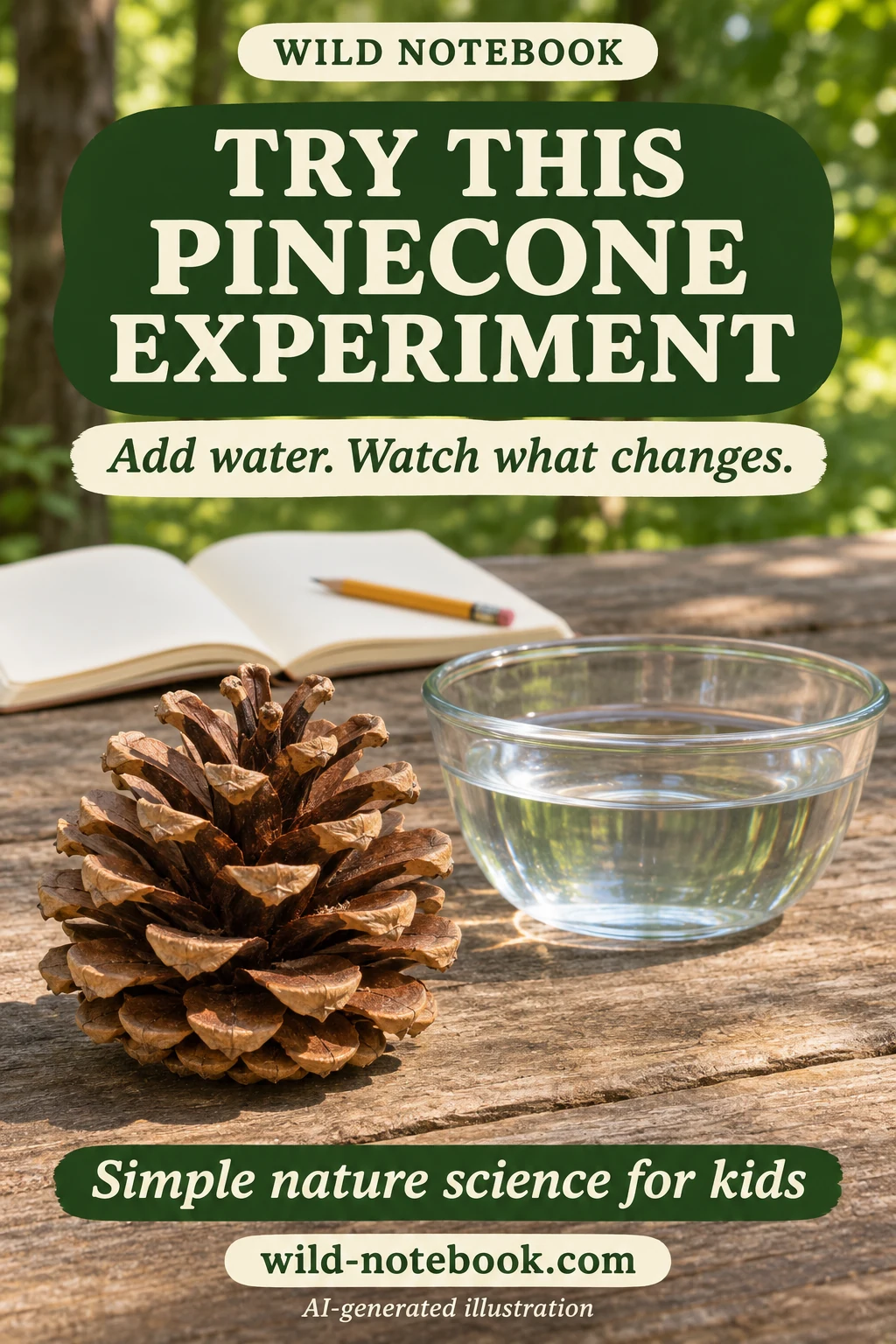
What you need
- One intact, brown, open pinecone collected from the ground
- A bowl or wide cup large enough for the cone
- Room-temperature water and a towel or tray
- A notebook and pencil; a ruler or camera is optional
- Optional: a second similar cone to keep dry for comparison
Collect where you have permission, choose a cone without visible occupants, and leave most fallen material in place. Use an untreated cone rather than one covered in craft paint, glue, or fragrance. Help younger children handle prickly scales.
Try the pinecone water experiment
- Record the starting shape. Look at the spaces between the scales. Sketch or photograph the cone. If you measure its width, use the same position each time.
- Make a prediction. Will the cone spread wider, pull inward, or stay the same? Write your guess before adding water.
- Wet the cone. Place it in the bowl and add water to wet its scales. If it floats, gently turn it so all sides get wet. Leave the comparison cone dry.
- Return for short checks. Observe roughly every 15 minutes during the first hour. Note any change; these are check-in times, not a deadline for closing.
- Let it dry. After about an hour, lift it onto the towel or tray. Revisit it later that day and the next morning. Compare its shape with your first drawing.
Take photos from the same angle. A small shift is easier to spot when you can compare it with a starting image.
Why do pinecones close when wet?
The woody scales absorb water. Different tissues within each scale swell by different amounts, causing it to bend inward. As the cone dries, the scales can spread outward again. Scientists call this a hygroscopic response: a change driven by taking up or losing moisture.
The moving tissues of a mature, fallen cone are dead. The movement comes from their physical structure, so a cone can respond without growing new tissue or using muscles. Wetting and drying can make the movement happen repeatedly. [1]
What does this have to do with seeds?
In pines with wind-dispersed seeds, open scales allow seeds to leave the cone. Closing in wet conditions limits their release when conditions are less favorable for wind dispersal. A cone you find may have already shed its seeds, while its scales can still respond to water. [2]
Keep a simple observation log
Copy this into your notebook. “No visible change” is a useful observation too.
| Check | What do the scales look like? | Sketch, photo, or width |
|---|---|---|
| Before water | ________ | ________ |
| 15 minutes | ________ | ________ |
| 30 minutes | ________ | ________ |
| About an hour | ________ | ________ |
| After drying | ________ | ________ |
Finish with two sentences: “I predicted…” and “I observed…” They do not have to match. Changing your mind after looking carefully is part of the activity.
What if your cone barely changes?
Cones vary in size, structure, and condition. Researchers have measured response times ranging from minutes to hours in scales from different species, so there is no single countdown that fits every cone. [1] Drying a whole cone can extend the activity through the day or overnight. [3]
Check whether your cone was already nearly closed at the start. If so, let it dry and try again once its scales have spread. If it is badly damaged, try another intact, open cone. Avoid prying the scales apart.
Can a pinecone predict rain?
Pinecones respond to moisture, including humidity in the air. [1] Our water bowl makes that response easier to investigate. For this activity, treat the cone as a moisture demonstration rather than a forecast: its shape does not give you an exact time for the next rain shower.
For a follow-up, photograph the same cone in a sheltered outdoor spot over several days. Record whether its surroundings are wet or dry and how its scales look. Keep your notes about what happened separate from guesses about tomorrow.
Keep the curiosity going
Try a sixty-second nature note on your next walk, or turn another dry cone into a pinecone hedgehog. For a different close-up investigation, explore one leaf and its tiny neighborhood.
Find more Wild Notebook discoveries on Pinterest, TikTok, and YouTube.
Sources and further exploration
- Reyssat, E. & Mahadevan, L. (2009). Hygromorphs: from pine cones to biomimetic bilayers. Journal of the Royal Society Interface.
- Poppinga, S. et al. (2017). Hygroscopic motions of fossil conifer cones. Scientific Reports. Includes the mechanism and its role in seed release.
- Paleontological Research Institution. Weather Instruments. Family instructions and timing for a pinecone humidity investigation.
- Royal Botanic Gardens, Kew. Pine cone investigation (PDF). More ideas for measuring and recording changes.